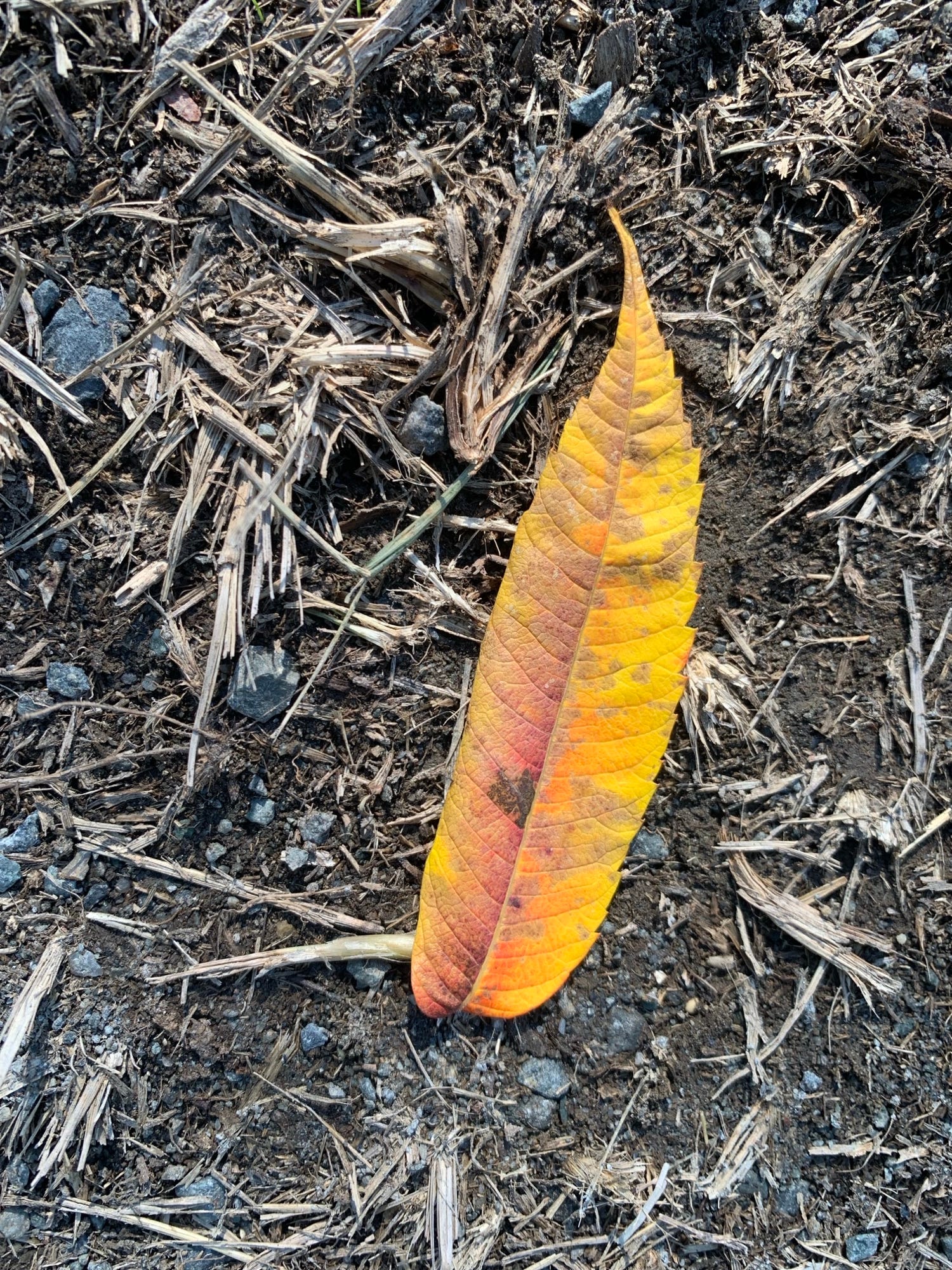
An Enormous Amount of Styrofoam
September 1 - September 9

Hello, lovelies! At some point, the crisp fall weather will kick in, but for now, I’m complicatedly enjoying the unseasonably warm weather. I know that it’s probably climate change, and that the ponds and rivers near my house have receded from their banks like gums on old teeth. But the leaves are so crackly under my feet, and the breeze is so pleasant on my bare arms! The apples are warm in my hands when I pick them up at the farmstand! I cannot control the weather. I can go out and harvest a bag of trash and sort it into the recycling bin and the trash can. I hope you also find manageable things to worry about this week.
Alright, deep breath in and out. Maybe stretch those arms behind you and unknot those crumpled shoulders.
Enjoy the rest stop.
September 1
one cupful of shredded styrofoam
The first day of classes, and it’s still there. A pile of shredded blue and white styrofoam pieces, which someone, at some point, dumped next to the brightly-painted little maintenance shed next to the walking path. I first encountered this pile of styrofoam back in April, or perhaps early May, and it is still here. It does not melt or decay or show any signs of time passing, and this makes it more unnatural to me than anything else that I pick up along the river. It unnerves me, and also overwhelms me, because there’s so much of it that I have no idea how to pick it up, and it wouldn’t all fit in my Market Basket bag at once, and so I tend to circle around and ignore it entirely.
But today there is a discarded coffee cup nearby, and so I scoop some styrofoam confetti into the cup and put it into my bag. The pile is hardly diminished, but tomorrow I can take away one more scoop, and another the day after that. In two or three months, perhaps, it will be gone. This feels like a very long time for a human being. I am used to quick results. But in that sort of time, a tree would perhaps add an inch or two to its height. In one century, perhaps two, it would be large enough to shade a family. It may take months to clear away the styrofoam, but the months will pass anyway. I am sure, at least, that the styrofoam isn’t going anywhere.
September 1
one case worth of Truly cans
The students are back in Boston. I can tell by the long lines in the coffee shops, as well as the increased numbers of early-morning runners along the river path. I cannot quite believe that this many people in the world actually enjoy running, but since I like to sleep in a tent after hiking up 4000-foot mountains, I try to keep an open mind about other people’s hobbies. Still, I wonder, in the same way that I wonder about people who go to church daily or drink a six-pack of Trulies or start planning for law school in ninth grade. Do they like it, or do they like the idea of being the kind of person who likes it?
I believe there are some people who truly enjoy those things, and I have no need or desire to judge. But I think the number of people who honestly enjoy these activities is smaller than the number of people engaging in them, and it panics me to imagine all the hours of finite lives spent on hobbies the hobbyists do not enjoy. All the quiet desperation caused by the pull to be well-rounded or athletic or moral or social or respected.
I have, on occasion, been given each of those labels by someone else, which is how those sorts of labels usually work. They were satisfying, very satisfying. They certainly made my life easier. But those labels did not feel like mine, but rather a badge to a club where I had to pay consistent dues, or else they would rip up my membership card and bar me at the door. To earn something means, inherently, that you do not have the power to decide whether you deserve that thing yourself, nor to control when it is given or taken away. You have outsourced that power to someone or something else. And so labels that I have earned never quite felt like they belonged to me. Those labels did not feel like watching the mist over the river slowly exhale into the sunlight, or like nodding to the geese and watching their black heads swing towards me, for a moment, in acknowledgement. Those labels did not make me feel alive.
September 1
approximately twenty pieces of styrofoam
I believe that humanity’s most enduring legacy will be styrofoam. Forget monuments or asphalt roads or even our cemeteries full of bones, these polystyrene bits will last until the heat death of the universe. I feel like they engage in asexual reproduction, constantly splitting into smaller un-compostable pieces, and burrowing down into the soil like beetles.
I stopped this entry midway and went back to work, then took a walk in the early afternoon, and encountered what I thought was a rather miraculous rock floating in the Charles River, which was actually a huge chunk of dirt-covered, weather-hardened styrofoam. I could not reach it to pull it out of the water, nor would it have fit in my bag. I wonder if I should write a science fiction story about a future world where all houses are made out of styrofoam, in an attempt to repurpose an indestructible material. I wonder if perhaps, this is a legitimate climate-repair option.
September 1 (afternoon)
six fistfuls of shredded styrofoam
I decided, this afternoon, to return to the giant pile of styrofoam and make a slightly larger dent in my months-long project. At the beginning of this longform essay, I promised myself that I would not engage in the pernicious autobiographical habit of living my life to make it more engaging to readers. I would not allow the opinions of the potential reader to change my writing or my habits.
And yet this was a senseless promise, because the thought of my potential readers, all five or so of them, does prompt me to get up when I don’t really want to, and walk wearily out the door, and grumblingly pick up a few pieces of trash until some precocious squirrel or shy, sneaky idea makes me happy I went out, after all. I am very used to feeling other people pressing in on me, like balloons, slowing and stifling my movements. I am new to the idea of other people lifting me up.
The styrofoam is really only scoopable by hand. Cups don’t work, and neither does the waterlogged baseball cap I found under an oak tree. But I feel good about getting a little more styrofoam out of the earth, and about reintroducing a small patch of soil to the sun.
September 9
the top of a coconut
I’m unsure how it got here, or where the rest of the coconut went. I don’t think coconuts can grow in New England, but imagining it makes me think of the honeybees and the zebra mussels and the other so-called invasive species of the world, who are now being terrorized by groups of middle-aged women in defense of native plants. It’s not that I disagree with the underlying message that humans need to pull back on trying to change environments to suit them, and learn to adapt to specific environments. But the idea of punishing something alive for coming to a new place and thriving feels wrong to me, somewhere deep down. The problem with reacting to change in the pursuit of balance is that who are we, as humans, to decide what balance is? The world was always going to change, and certain species were always going to die out and new ones were always going to swarm into the newly-empty spaces, multiplying at a terrifying bacteria-like rate until something else adapted to kill it, until something different adapted to kill it more efficiently, until another species came along entirely to upset the the balance, except there never really is such a thing as balance in a living, breathing, constantly-revolving world anyways.
And I do not argue that humans have had an outsized and destructive impact on the environment, given the speed at which we transport seedlings and insects and unknown fungi across the globe, and given the voracious desires of comfort and consumerism that lead us to hunt species out of existence and standardize the crop fields so our favorite fruits are always on hand. I know we must learn to live more lightly upon the earth. But I fear that in our zeal to preserve, sometimes we forget that death has always been. It is probably wiser, in the long run, to pull back our blows on the beings that still exist than to tear up shrubs in the name of resuscitating what is already gone. Because frankly, you will never, ever get all of that wisteria out of the forest, and you’re only delaying nature’s attempts to reach an understanding.
The desire to delay death is present in all mortal beings. But the belief that death can and should be delayed forever, on an individual or species scale, appears to be the sole province of humans. There are so many people out there inventing, testing, writing, living under the assumption that some day, humans will conquer death. I worry that some of this has bled over into preservation efforts, without anyone questioning the underlying assumption that death is something to be conquered.
I will plant clover in my yard someday, if I can afford a yard, and I will try to grow milkweed for the monarchs and let the ferns and wild strawberries linger at the edges of the trees. I will smile when I see a dandelion. And if these species are taken over by others, I will let the others come. Life, I’ve found, rarely needs my help to go on living, and death doesn’t need my assistance much, either. Between them, they’ve got the world firmly in hand, if humans would stop trying to do their work for them.